Call the BFCC-QIO on or before the planned discharge date. The number is printed on a form your parent already received.
Within two days of admission, every Medicare patient is given an Important Message from Medicare (form CMS-R-193). It names your regional Beneficiary and Family Centered Care Quality Improvement Organization — the BFCC-QIO — and gives its phone number. Call and say you are requesting an expedited review of a discharge you believe is premature.
The QIO must decide within one calendar day of receiving the information it needs — typically a one to two day turnaround. If you file on time, you are generally not liable for new inpatient charges, beyond usual cost sharing, until noon of the day after you receive notification of the decision. The appeal is free.
The form nobody reads
Somewhere in the paperwork your parent was handed on admission is a two-page notice titled An Important Message from Medicare About Your Rights. Hospitals are required to deliver it within two days of admission, and again within two days of discharge.
It arrives in a stack, at a moment when nobody is reading anything, and it looks like every other consent form. It is not. It is the only document in that stack that gives you a mechanism to slow the hospital down.
Sources: 42 CFR 405.1206; CMS Transmittal 11210, January 2022.
Why discharge feels rushed — and why it isn't personal
The average Medicare hospital stay is 5.3 days. If your parent has been in for four days and someone has started saying "discharge," that is the system running normally.
Hospitals are paid a fixed amount per discharge under Medicare's diagnosis-related group system — a set rate for the condition, regardless of whether the stay runs three days or thirteen. Spend less than the rate and the hospital keeps the difference. Medicare fee-for-service hospital margins ran at roughly negative 13% in 2023.
Source: MedPAC, March 2025 Report to Congress.
The discharge planner is not your adversary. But nobody in the building is financially incentivized to slow down on your behalf. If more time is needed, you have to ask — and know the mechanism.
How the appeal works
-
Find the Important Message from Medicare
Form CMS-R-193. Check the admission paperwork. If you cannot find it, ask the case manager or patient services for a copy — they are required to have provided it. Failing that, call Medicare on 1-800-633-4227 (TTY 1-877-486-2048) and ask for your regional QIO.
-
Call the QIO on or before the discharge date
This is the deadline that matters. Use the number printed on your own notice — QIO organizations are regional and the numbers change, so a number you found online may be wrong. Say you are requesting an expedited review of a discharge you believe is premature.
-
Explain why, in functional terms
Not "she isn't ready." Instead: cannot walk to the bathroom unaided; nobody at home during the day; the wound is not healing; fell yesterday; cannot manage the stairs and the only bathroom is upstairs. Concrete and observable beats general worry.
-
Stay put while it is reviewed
The QIO will request the medical records and review the case independently of the hospital. Your parent remains in the hospital during the review.
-
Get the decision within about a day
The QIO must decide the appeal within one calendar day of receiving the information it needs. In practice, a one to two day turnaround.
The part that surprises people: you are protected while you wait
If you filed on time, you are not liable for new inpatient charges — beyond the deductible and coinsurance you would owe anyway — until noon on the day after the QIO issues its decision.
Appealing does not expose you to a bill for the extra days. That is the single most common misconception about this process, and it stops families from using a right that costs them nothing.
Source: 42 CFR 405.1206.
What to say
To the case manager: "We don't think this discharge is safe yet. I want to file a fast appeal with the QIO. Can you give me the Important Message from Medicare with the QIO number on it?"
To the QIO: "I'm requesting an expedited review of a discharge decision. My parent is being discharged today and we don't believe it's safe."
Have ready: your parent's Medicare number, the hospital name, the planned discharge date, and two or three specific functional reasons. Write down who you spoke to and when.
Where this sits in the month
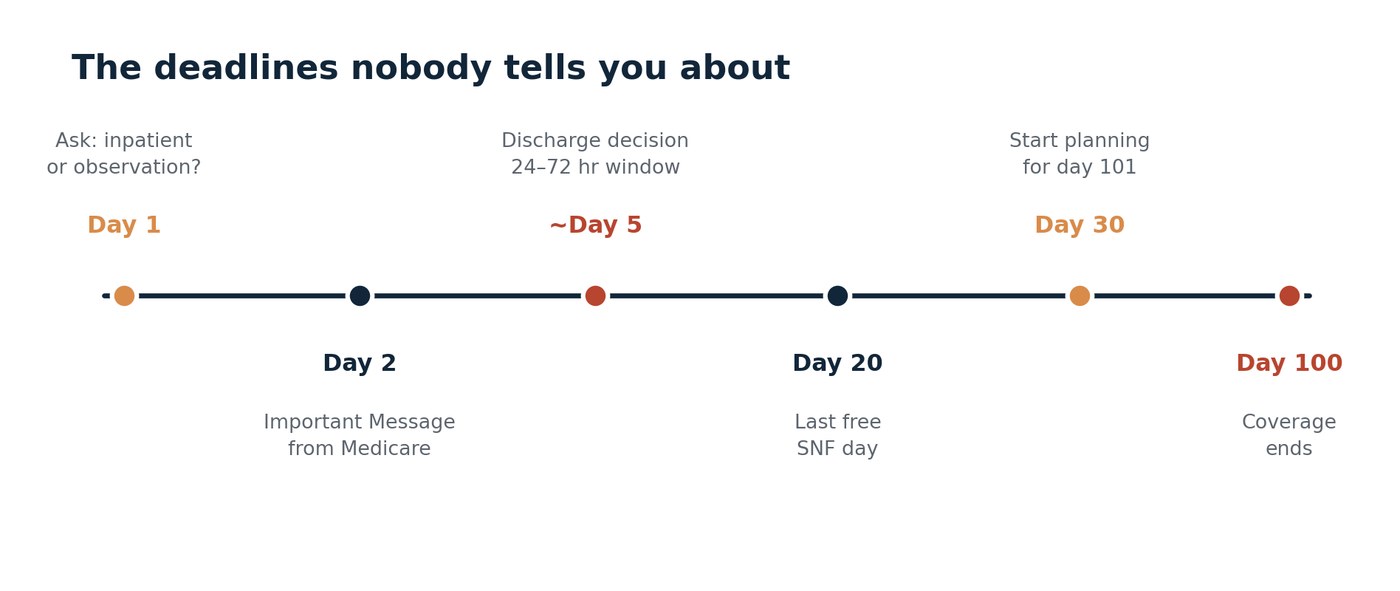
The fast appeal is one deadline. There is also the observation-status question that decides whether Medicare pays toward rehab at all, the coinsurance that starts on day 21, and the notices a facility owes you in the first 48 hours.
The 100-Day Clock is a 92-page fillable PDF covering the whole first month — 10 tools, instant download, $99. See what's inside.
What happens if you lose
If the QIO agrees with the hospital, discharge proceeds. You have lost a day and paid nothing extra for the review period.
That asymmetry is the whole argument for using it. The downside is a day. The upside is time your parent's own clinicians agreed they needed.
If you miss the deadline, you can still request a QIO review during the same hospitalization — without the financial protection — or use the standard appeals process within 30 days after discharge.
The same right exists in rehab and home health
The mechanism repeats later, under a different form name, and this is where families are caught out a second time.
When coverage is ending in a skilled nursing facility, home health, or hospice, you should receive a Notice of Medicare Non-Coverage (NOMNC) at least two days before it stops. The appeal deadline there is noon on the day before coverage ends.
| Setting | Notice | Deadline to appeal |
|---|---|---|
| Hospital | Important Message from Medicare (CMS-R-193) | On or before the planned discharge date |
| Skilled nursing facility | Notice of Medicare Non-Coverage | Noon the day before coverage ends |
| Home health | Notice of Medicare Non-Coverage | Noon the day before coverage ends |
If your parent is on Medicare Advantage
The discharge appeal above still applies. But Advantage plans add a second layer — they can also deny coverage for the skilled nursing facility itself, separately from the hospital discharge decision. Those denials are worth challenging: federal investigators found 95% of appealed denials were overturned.
Before you call: two things worth checking
First, confirm inpatient status. Ask whether your parent was formally admitted as an inpatient or is under observation. Observation nights do not count toward the three inpatient days Medicare requires before it will pay for a skilled nursing facility — so a discharge fight can be moot if the coverage was never going to exist.
Second, ask for a home safety assessment. If the concern is that home is unsafe, request an occupational therapy pre-discharge home evaluation. A systematic review found these reduced fall risk by roughly 32% in geriatric and rehabilitation settings. It also produces documentation that strengthens the appeal.
Why this matters more than its length suggests
Nothing else available to a family in this situation is simultaneously this valuable, this fast, this free, and this unused. It costs one phone call. Filed on time, it carries no financial downside.
And even if you never use it, knowing it exists changes the discharge conversation. You are no longer being told what will happen. You are participating in a decision.
This is one deadline out of six
There is also the observation-status question that decides whether Medicare pays anything at all, the Medicare Advantage denial playbook, and the coverage cliff at day 101. The 100-Day Clock is an 92-page guide with 10 fillable tools covering the whole first month.
See the guide — $9992-page PDF · 10 fillable tools · instant download · 30-day refund, no questions
Sources
- 42 CFR 405.1206 — Expedited determination procedures for inpatient hospital services
- CMS Transmittal 11210 (January 2022) — Important Message from Medicare, form CMS-R-193
- MedPAC, March 2025 Report to Congress — hospital payment and length of stay
- Medicare.gov — Your right to a fast appeal
Figures verified against primary sources and current as of . Medicare amounts are reset by CMS each January — confirm the current year before acting. This article is educational reference only and is not legal, medical, or financial advice.