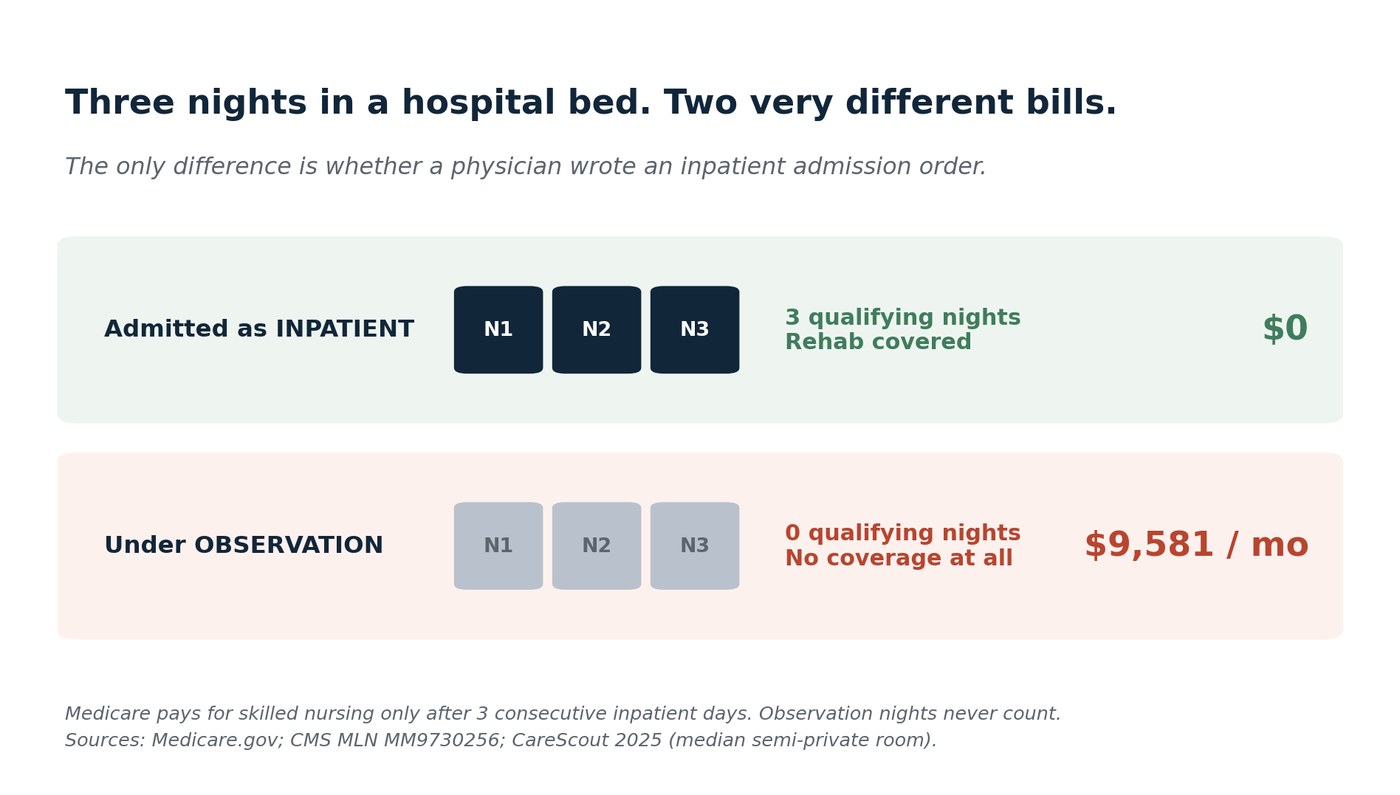
Your parent can sleep three nights in a hospital bed and not be “admitted.”
It's called observation status, and it is the most expensive
misunderstanding in American eldercare.
Under Medicare's rules a person is an inpatient only from the moment a
physician writes a formal admission order. Without it they are an outpatient under
observation — no matter how many nights they're there, no matter how sick they
are, no matter what anyone calls them.
And Medicare pays for rehab only after three consecutive inpatient days.
Observation nights don't count. Not one.
The same three nights. The difference is one administrative order.
“Has my mother been formally admitted as an inpatient, or is she under
observation? Can I get that in writing?”
Families find this out at the nursing facility's front desk, when a bill of roughly $315
a day turns out to be entirely theirs. That question, asked on day one and repeated daily,
is worth more than the price of this guide many times over.
The 100-day clock
Almost every family believes Medicare covers rehab.
It does — partially, conditionally, and for a strictly limited time.
The gap between what people assume and what's true is where the bills come from.
Skilled nursing coverage, per benefit period
2026 figures, per CMS
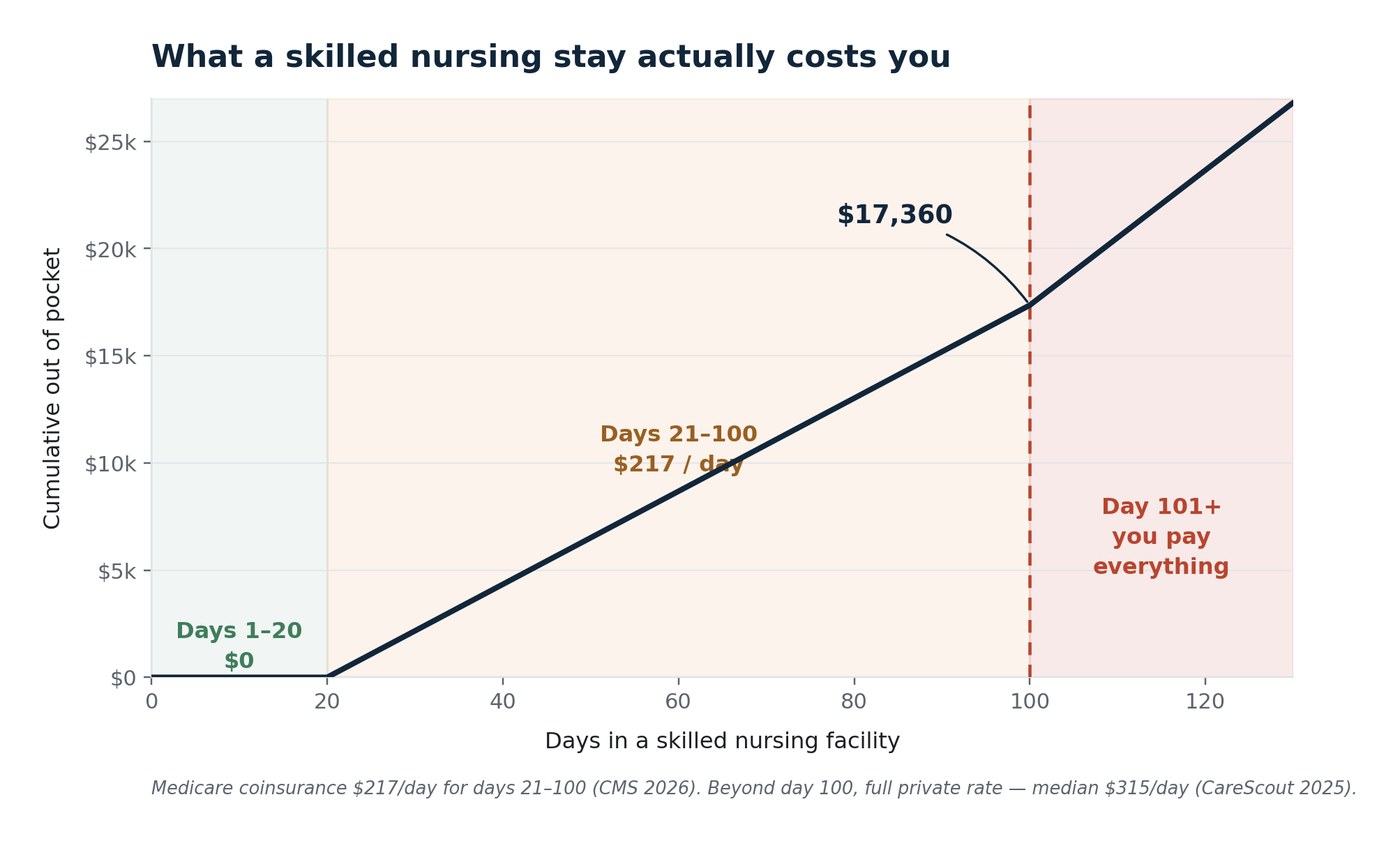
Days 1–20
Medicare pays in full
$0
Days 21–100
Daily coinsurance
$217 / day
Day 101 onward
Medicare pays nothing
Everything
Eighty days of coinsurance is $17,360 — and then coverage ends
entirely, at a median nursing home cost of around $9,581 a month.
Cumulative out-of-pocket cost across a skilled nursing stay.
The guide shows exactly where you are on that clock, what resets it, when to start
planning for day 101 (around day 30, not day 95), and the free appeal that can buy you time
when a discharge comes too soon.
The method
Three things, in this order
The guide is sequenced by when you need it, not by topic — because
when you're panicking, you don't know which topic you're in.
01
Establish where you stand
Confirm inpatient versus observation status. Find out whether the legal documents
exist. Get one named contact. Start a log.
Day one work. Four questions, about ten minutes, and it determines
everything financial that follows.
02
Work the decision
Rehab, home, or facility — with the actual coverage math rather than
abstractions. How to read facility quality data, and what it doesn't show.
Plus the appeal. Free, decided in about a day, and filing on time
carries no financial downside.
03
Protect the money
What care actually costs. The VA benefit families routinely never claim. And the five
moves well-meaning people make in month one that are close to impossible to undo.
Before anyone acts. Not after.
A look inside
Seven parts, 92 pages, ten fillable tools
Every figure dated and sourced to CMS, Medicare.gov, or the HHS Office of
Inspector General.
Part01
The first 72 hours
The observation trap. Who in the building actually helps. The four documents and
what happens when they don't exist. And what to ask depending on whether it was a
fall, a stroke, a dementia diagnosis, or a slow decline.
What you getYou stop guessing and start asking the
questions that change the outcome.
Part02
The discharge decision
Why everyone's in a hurry — it's structural, not personal. The 100-day clock
in full. Rehab versus home versus facility with real coverage math. Medicare Advantage
denials. And how to appeal a discharge, free, in about a day.
What you getYou participate in the decision instead of
being told what will happen.
Part03
The money
What care costs. The four ways families pay. The VA benefit routinely never
claimed. The five costly mistakes. And the Medicaid conversation — including the
exceptions most people never hear about.
What you getYou avoid the moves that quietly destroy
options you didn't know you had.
Parts4–5
The family, and going home
Running the first family meeting. Dividing work when “even” is
impossible. The driving and moving conversations. Then: the home safety assessment you
have to request, medication reconciliation, and the 30-day readmission window.
What you getFewer of the arguments that outlast the crisis
by years.
Parts6–7
The toolkit and reference
Ten fillable tools — type into the PDF and your entries save. Two come
already completed as worked examples. Plus a glossary of every acronym they'll throw
at you, and an honest guide to the free resources.
What you getSomething you actually use at the bedside, not
a book you mean to read.
What's included
Everything in one file
One PDF. No login, no course platform, no video modules.
Every figure below is sourced and dated. If you only came here for the facts, take them — they are free, and they are the same facts in the guide.
How many days of rehab does Medicare pay for?
Up to 100 days per benefit period. Days 1–20 cost you nothing. Days 21–100 carry a coinsurance of $217 per day (2026). From day 101 Medicare pays nothing. The clock resets only after 60 consecutive days with no inpatient hospital and no skilled nursing care.
CMS MLN Matters MM14279, effective 1 January 2026.
Does observation status count toward the 3-day rule?
No. Medicare pays for skilled nursing care only after a medically necessary inpatient stay of at least three consecutive days. Observation nights are billed as outpatient care and never count — even if your parent slept in a hospital bed every one of them. A patient becomes an inpatient only when a physician writes a formal admission order.
Medicare.gov, Skilled nursing facility care; CMS MLN MM9730256.
Can you appeal a hospital discharge that feels too soon?
Yes, and it is free. Every Medicare patient receives an Important Message from Medicare (form CMS-R-193) within two days of admission. It names your regional BFCC-QIO and its phone number. Call the QIO on or before the planned discharge date to request an expedited review. The QIO must decide by within one calendar day of receiving what it needs. File on time and you are generally not liable for new inpatient charges — beyond usual cost sharing — until noon the day after the decision.
42 CFR 405.1206; CMS Transmittal 11210, January 2022.
How often are Medicare Advantage nursing home denials overturned?
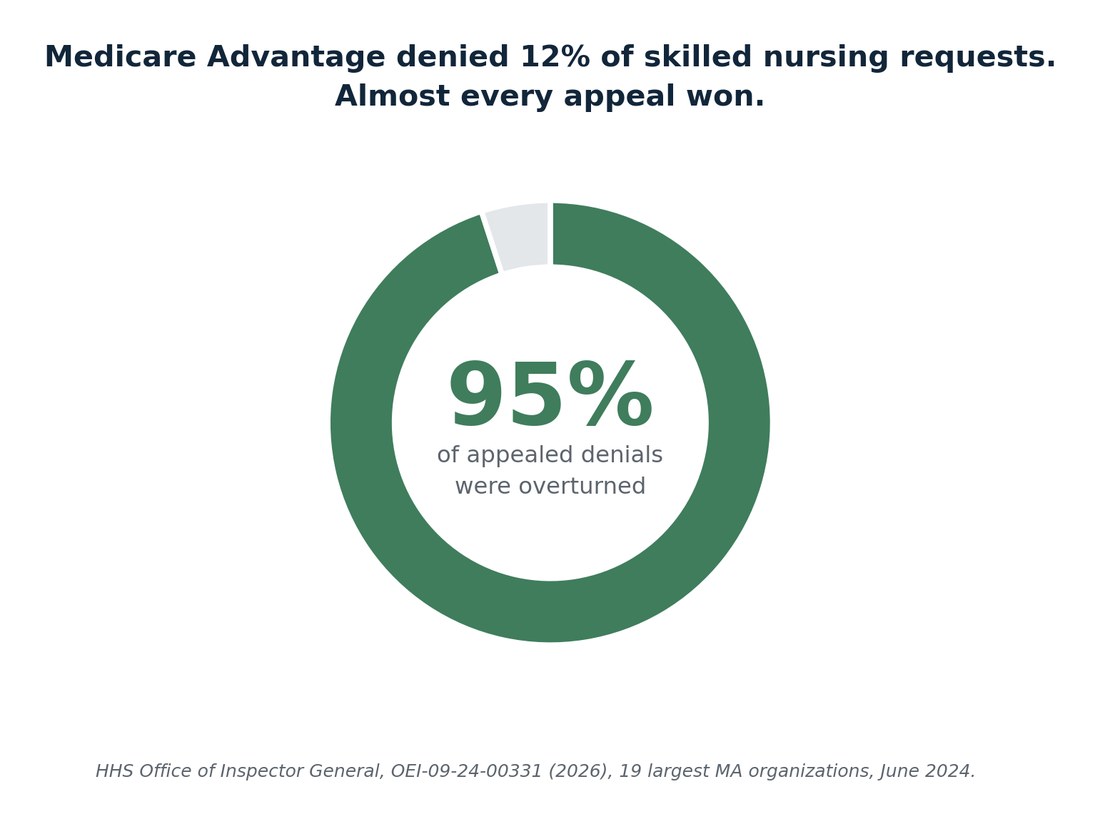
95% of appealed denials were overturned. A 2026 HHS Office of Inspector General report examined the 19 largest Medicare Advantage organizations and found they denied 12% of skilled nursing admission requests in June 2024, with plan-level rates from 0.4% to 23%. Almost every appealed denial was reversed — which tells you what the initial “no” was worth.
HHS Office of Inspector General, OEI-09-24-00331 (2026).
HHS Office of Inspector General, 2026.
What happens after the 100 days end?
Medicare pays nothing from day 101. Families then pay privately, claim on a long-term care policy if one exists, apply for VA Aid & Attendance if the parent is a wartime veteran or surviving spouse, or apply for Medicaid. Median nursing home cost is around $9,581 per month semi-private. Because Medicaid involves a 60-month look-back on asset transfers, planning should start around day 30, not day 90.
CareScout 2025 Cost of Care Survey; Deficit Reduction Act of 2005.
Does Medicare pay for long-term care at home?
No. Medicare explicitly excludes custodial care — help with bathing, dressing, eating, supervision — at home or in a facility. Home health is covered only when the patient is homebound, needs skilled nursing or therapy on a part-time or intermittent basis, has a physician’s order, and uses a certified agency. In practice that caps around 8 hours a day, 28 hours a week.
CMS MLN906765, Items & Services Not Covered Under Medicare, September 2025.
Figures verified against primary sources and current as of . Benefit amounts are reset by CMS each January — confirm the current year before acting.
The obvious objection
“The hospital already gave me a checklist.”
They did, and you should use it. Medicare publishes a discharge planning checklist —
free, six pages, genuinely well-intentioned. It also contains this instruction:
“Ask about problems to watch for.”
It never says what those problems are. It can't — it has to serve every diagnosis,
every hospital, and every situation in the country simultaneously. So it gives you a blank
line and wishes you luck.
That's the difference. Generic guidance tells you to ask a question. This tells you
which question, who to ask, what a good answer sounds like, and what to do
when you don't get one.
Straight answers
What this isn't
We'd rather you know before you buy than feel misled after.
It isn't legal, medical, or financial advice. It explains how systems work and
what to ask. It doesn't tell you what to decide, and it repeatedly tells you when to call
a professional.
It contains no legal document templates. Requirements vary by state and a
defective power of attorney discovered after incapacity is a catastrophe. We explain what
each document does and send you to someone licensed where you live.
It contains no Medicaid asset-protection strategy. That's an attorney's job. We
explain that the look-back exists and why innocent-looking moves backfire.
It isn't emotional support. There's one honest page about guilt. The rest is
decisions, deadlines, and money.
It isn't an ongoing coordination app. If your family needs shared task tracking
over months, MySageBeam does that properly — free tier plus about $19/month.
Different job. We have no commercial relationship with them.
It's US-specific. Medicare, Medicaid, and VA rules.
Get the guide
One payment. Yours permanently.
One-time purchase
The 100-Day Clock
$99
USD · instant download
What's included
92-page guide, sequenced across the first 30 days
10 genuinely fillable tools — type and save
Two worked examples showing the tools completed
The Corridor Card — one page for the hospital
Six question scripts for the conversations that matter
Full glossary of everything they'll say to you
Every figure dated and sourced to CMS and Medicare.gov
Secure checkout · delivered by email in under a minute
30-day refund, no questions asked
Educational reference — not legal, medical or financial advice
Free guides
Start with these. They cost nothing.
Three of the six deadlines, written up in full and sourced.
What do I need to open it, and can I use it on my phone?
Yes, phone included — open it in Adobe Acrobat Reader,
which is free on iPhone, Android, Windows and Mac. Type into the tools and your entries save
into the file, on a phone as well as a computer.
One thing worth knowing: some built-in viewers can't fill in PDF form
fields at all — Samsung Notes and a few browser PDF viewers among them — and the tools
will look blank in those. Acrobat Reader is the reliable one, and it takes a minute to install.
The hospital already gave me a checklist. Why do I need this?
Use theirs too — it's a decent drug list and appointment log.
What it won't tell you is whether your parent is under observation, what the three-day
rule means for you, how to appeal a discharge, or which of the five financial mistakes
you're about to make. It can't: it's six generic pages that must serve every patient in
America.
There's a discharge planner. Isn't that their job?
Partly, and many are excellent. But they carry caseloads of dozens,
they work for an institution paid a fixed amount per discharge regardless of length of
stay, and their obligation largely ends when your parent leaves the building. They are
not neutral, and they are not yours.
I don't have time to read 92 pages.
You're not meant to. The first page is a four-minute list of what to
do today. The second is a single card you can photograph. After that each part is
sequenced to the moment you need it — you read Part Two when discharge comes up,
not before.
Can I really type into it?
Yes. All ten tools have real form fields. Type in Acrobat, Preview,
or any standard PDF reader and your entries save with the file. You can also print them
if you'd rather work on paper.
Does this apply in my state?
The Medicare rules — the clock, the three-day requirement,
observation status, discharge appeals — are federal and apply everywhere in the
US. Medicaid rules, power of attorney requirements, and guardianship procedures are
state-specific, and the guide is explicit about that every time it comes up. It routes
you to the right authority in your state and gives you a worksheet to record them.
My parent is already in rehab. Is it too late?
No. Most of the highest-value material — the 100-day clock, the
coverage cliff, the appeal rights when coverage ends, the five financial mistakes, the
readmission window — applies from wherever you are now. The money sections matter
most in weeks two to four.
Money is tight right now.
Then take the refund if it doesn't help — 30 days, no
questions. And if $99 genuinely isn't possible this month, use the free resources listed
in Part Seven. We name them, link them, and tell you honestly what each is good for.
You'll be better off than you were, which matters more than whether we make a sale.
What if it isn't what I need?
30 days. No questions. No forms. No “tell us why.”
Email us and the money goes back.
We're aware of who's buying this — people under financial pressure at a
frightening moment. A guarantee that makes you justify yourself isn't a guarantee.
Who wrote this?
It's a research-led guide built from primary sources — CMS
regulations and notices, Medicare.gov, MedPAC reports, HHS Office of Inspector General
findings, AARP and Family Caregiver Alliance research, and CDC guidance. Every
substantive claim is cited so you can verify it. It is not written by an attorney or a
physician, which is exactly why it tells you to consult one wherever that's the right
answer.
The 100-Day Clock — $99
Educational reference · not legal/medical/financial advice
We’d like to measure whether our advertising works, which means sharing page views with Meta.
Because this site is about a parent in hospital, that’s your call, not ours.
What we collect ›