Appeal it. The overwhelming majority of appealed denials are reversed.
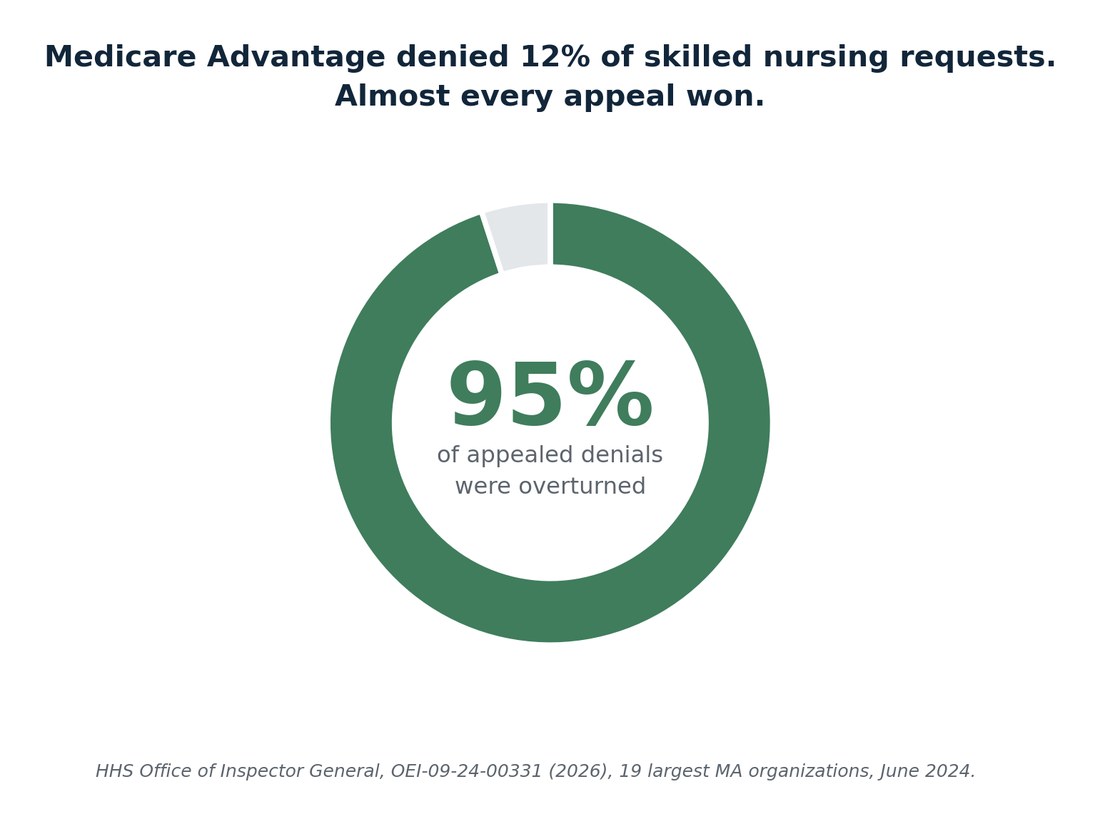
A 2026 report from the HHS Office of Inspector General examined the 19 largest Medicare Advantage organizations and found they denied 12% of skilled nursing facility admission requests in June 2024. Of the denials that were appealed, 95% were overturned in the patient's favor.
Plan-level denial rates ranged from 0.4% to 23% — a spread that has more to do with which insurer you have than how sick your parent is. Ask the hospital case manager to file an expedited appeal today, and ask the attending physician for a peer-to-peer review. Both are free.
What the denial actually means
Your parent is medically ready to leave the hospital but not ready to go home. The hospital has recommended a skilled nursing facility for rehabilitation. And the Medicare Advantage plan has said no.
It is worth being precise about what has happened, because the language obscures it. The plan has not made a clinical finding that your parent is well. A utilization reviewer — who has not examined your parent, and who may not be a physician — has determined that the request does not meet the plan's internal criteria for coverage.
That is a different thing, and the numbers show it.
The 95% figure, and what it tells you
In 2026 the HHS Office of Inspector General published findings from a review of the 19 largest Medicare Advantage organizations. Looking at skilled nursing facility admission requests in June 2024, it found:
- 12% of requests were denied across those organizations
- Plan-level denial rates ranged from 0.4% to 23%
- 95% of denials that were appealed were overturned in the patient's favor
- naviHealth, a UnitedHealth subsidiary that processes roughly half of all skilled nursing requests industry-wide, denied 14%, against 11% for plans reviewing in house
Source: HHS Office of Inspector General, OEI-09-24-00331 (2026).
A system where the overwhelming majority of challenged decisions get reversed is one where the appeal, not the initial review, is doing the real work.
Read the range again: 0.4% to 23%. Two Medicare Advantage plans, covering broadly similar populations, differing by a factor of more than fifty in how often they say no. Whatever explains that, it is not the medical condition of the patients.
The practical consequence
Read that 95% carefully, because the way it's usually quoted overstates it. It describes denials families chose to appeal — and only a minority are ever appealed at all. Those tend to be the cases with strong clinical facts and an engaged case manager, so it is not the odds facing any individual denial.
What it does tell you: a denial is frequently not the last word, the appeal is where the real review happens, and the cost of finding out is a phone call. That's reason enough without the number meaning more than it does.
How Medicare Advantage differs from Original Medicare
This situation largely does not arise under Original Medicare, which is why it blindsides families who assume all Medicare works the same way.
| Original Medicare | Medicare Advantage | |
|---|---|---|
| Prior authorization for a skilled nursing facility | Not required | Often required |
| Facility choice | Any Medicare-participating facility | May be restricted to network |
| The 3-day inpatient rule | Applies | Applies, but some plans waive it — ask |
| Who decides coverage | Medicare rules | The plan, applying its own criteria |
| Appeals | Through the QIO | Through the plan first, then external review |
One genuinely useful quirk: because some Advantage plans waive the three-day inpatient requirement, a parent who spent their hospital stay under observation status — and who would therefore get nothing under Original Medicare — may still qualify. It is worth asking explicitly.
The playbook
Move quickly. Expedited appeals have short deadlines, and the hospital is working to its own discharge timeline regardless of what the plan decides.
-
Get the denial in writing, with the specific reason
Not "it didn't meet criteria." Which criteria, and what clinical finding failed to meet them. You need this to rebut it, and asking for it in writing tends to concentrate minds.
-
Tell the hospital case manager you are appealing
Say it plainly: "We're appealing this denial. Can you help me file an expedited appeal today?" Case managers do this routinely and know each plan's process. This is the single highest-leverage phone call available to you.
-
Ask the attending physician for a peer-to-peer review
This puts your parent's actual doctor on the phone with the plan's medical director. It is often where denials collapse, because the reviewer is finally speaking to someone who has examined the patient.
-
File the expedited appeal
Expedited — sometimes called "fast" — appeals are for situations where waiting would jeopardize health or function. A parent who cannot safely go home qualifies. The plan must respond far faster than for a standard appeal.
-
Be specific about function, not feelings
Not "she's not ready." Instead: cannot transfer from bed to chair without two-person assistance; cannot manage stairs and the bathroom is upstairs; wound requires daily dressing changes nobody at home is trained to do; fell twice in the past week. Concrete, observable, functional.
-
If the plan upholds the denial, keep going
Medicare Advantage appeals run through five levels. Level 2 is an independent review entity outside the plan — a genuinely different set of eyes, and a meaningful escalation. Most families stop at level 1. The OIG data suggests they shouldn't.
What to say
To the case manager: "The plan has denied the skilled nursing request. I'd like to file an expedited appeal today. Can you walk me through it?"
To the plan: "I'm requesting an expedited appeal of a denied skilled nursing facility admission. Please confirm the deadline and where to send documentation."
To the attending physician: "Would you be willing to do a peer-to-peer review with the plan's medical director?"
Log every call — date, time, name, what was said, what they committed to. If this escalates, that record is the difference between your recollection and evidence.
The appeal is one piece of it
An expedited appeal deals with this denial. It does not tell you what the coinsurance becomes on day 21, what the facility has to give you in writing, or what happens when the 100 days run out.
The 100-Day Clock is a 92-page fillable PDF covering the whole benefit period — 10 tools, instant download, $99. See what's inside.
What to do while the appeal runs
Do not let the discharge clock run out unchallenged
The appeal against the plan's coverage denial is a separate track from any challenge to the hospital discharge itself. If the hospital is also pushing to discharge before you are ready, you have a second, independent right — a free QIO appeal decided in about a day. Both can run at once.
Ask the facility whether it will admit your parent pending the appeal. Some will, particularly if the clinical case is strong. Get any financial arrangement in writing before you agree to it — you do not want to discover later that you signed a private-pay contract for a stay the plan subsequently agreed to cover.
If you lose
Some denials are correct. If your parent genuinely doesn't need skilled care, the plan is right to say so, and continuing to fight helps nobody.
But before you accept it, be clear on what is being declined. A denial of skilled nursing facility coverage is not a finding that your parent needs no help. They may still qualify for home health — skilled nursing or therapy at home — which is covered under different rules. Ask the case manager to assess that instead.
What Medicare will not cover, whichever way the appeal goes
Medicare, including Advantage plans, does not cover custodial care: help with bathing, dressing, eating, or supervision. That is what most families actually need, and it is the one thing Medicare will not fund. Home health is covered only when the patient is homebound, needs skilled nursing or therapy on a part-time or intermittent basis, has a physician's order, and uses a certified agency — capping in practice around 8 hours a day and 28 hours a week.
Source: CMS MLN906765, September 2025.
The wider point
The denial is not the end of the process. Statistically, it is closer to the beginning of it. The OIG found that when families pushed back, the plan reversed itself 95% of the time — which means the initial denial was, in the great majority of cases, simply wrong.
Nobody at the hospital or the insurer is going to tell you that. It costs a phone call to find out whether your parent is in the 95% or the 5%.
The appeal is one deadline out of six
There is also the observation-status question that decides whether Medicare pays anything at all, the free discharge appeal most families never use, and the coverage cliff at day 101. The 100-Day Clock is an 92-page guide with 10 fillable tools covering the whole first month — what to do, what to ask, and when.
See the guide — $9992-page PDF · 10 fillable tools · instant download · 30-day refund, no questions
Sources
- HHS Office of Inspector General, OEI-09-24-00331 (2026) — Medicare Advantage skilled nursing facility prior authorization review
- CMS MLN906765, Items & Services Not Covered Under Medicare (September 2025)
- CareScout 2025 Cost of Care Survey
- Medicare.gov — Skilled nursing facility care
Figures verified against primary sources and current as of . Medicare amounts are reset by CMS each January — confirm the current year before acting. This article is educational reference only and is not legal, medical, or financial advice.