Four things matter in the first 48 hours. Everything else can wait.
1. Ask whether your parent has been formally admitted as an inpatient, or is under observation. This one question decides whether Medicare pays anything toward the rehab that may come next. Ask the case manager, get it in writing, and ask again tomorrow — status can change.
2. Find out whether a power of attorney and healthcare proxy exist. If your parent is conscious and able to understand what they are signing, a HIPAA release can often be signed at the bedside the same day.
3. Get the name and direct number of the case manager. Not the ward number — the named person. This relationship shapes the next month more than any doctor you speak to.
4. Start a log. Date, time, who you spoke to, what they said. By day nine, when three people have told you three different things, it is the most valuable thing you own.
You are competent at everything except this
You run teams. You manage budgets. You handle complexity for a living. And right now you are standing in a corridor with no idea what you are supposed to be doing, while everyone around you moves faster than you can think.
That is not a personal failure. You have been dropped into a system with its own rules, its own clock, and its own financial incentives, and nobody hands you the manual on the way in.
Here is what actually matters in the first two days.
1. The question that decides everything financial
Your parent goes to the emergency room. They are given a bed. They stay one night, then two. Everyone calls them a patient. To any reasonable person, they have been admitted.
They may not have been.
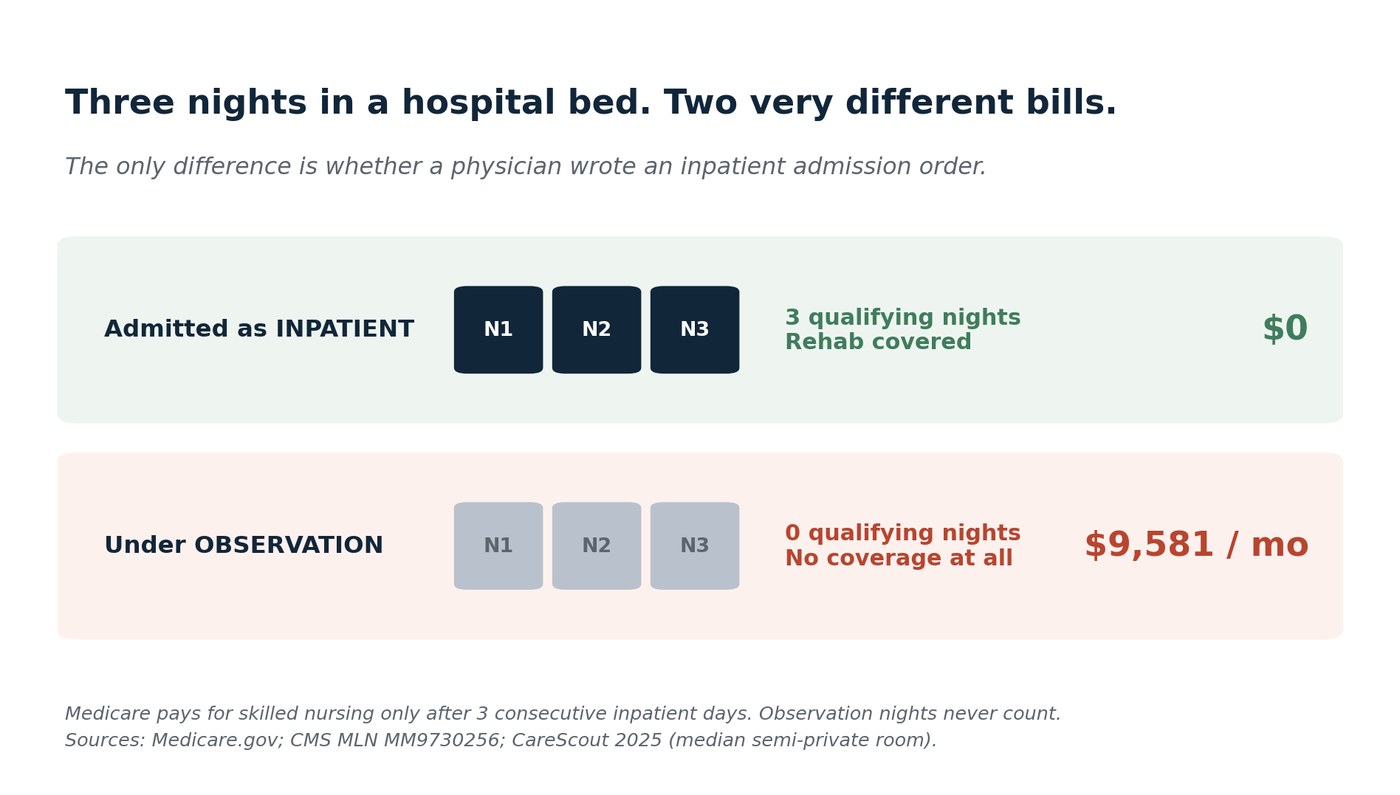
Under Medicare's rules, a person is an inpatient only from the moment a physician writes a formal inpatient admission order. Without that order they are an outpatient under observation — no matter how many nights they sleep there, no matter how sick they are, no matter what anyone calls them in conversation.
Why it costs so much
Medicare Part A pays for a skilled nursing facility only after a medically necessary inpatient hospital stay of at least three consecutive days. Observation days do not count toward those three. Not one of them.
So a parent who spent four nights in a hospital bed under observation, and who now needs rehab, arrives at the facility to find Medicare will contribute nothing. At a median of roughly $315 a day for a semi-private room, that is the family's bill from day one.
Sources: Medicare.gov; CMS MLN MM9730256; CareScout 2025 Cost of Care Survey.
Observation also bills differently in its own right. Inpatient care falls under Part A, where one deductible covers the stay. Observation falls under Part B: a $283 deductible in 2026, plus 20% coinsurance on every individual service — every X-ray, every lab, every IV — with no annual out-of-pocket cap.
Hospitals must give you a Medicare Outpatient Observation Notice (form CMS-10611, usually called the MOON) in writing and explained aloud within 36 hours of observation beginning. In practice it arrives in a stack of paperwork nobody is reading. Do not wait for it.
Ask the case manager, today
"Has my mother been formally admitted as an inpatient, or is she under observation status?"
"Can I get that in writing?"
"If she's likely to need skilled nursing care after this, does her current status qualify her for Medicare coverage of it?"
Write down the answer, the date, and who gave it to you. Status can change mid-stay, so ask again each day.
2. The paperwork that unlocks everything
There are four documents. They do different things, and people routinely assume one covers all four.
| Document | What it lets you do | The trap |
|---|---|---|
| Durable power of attorney (financial) | Pay bills, access accounts, deal with property | Durability is what to check — a POA only helps if it survives incapacity. States differ: many presume durability unless the document says otherwise; others require explicit language. Ask an attorney in your parent's state whether yours still works. |
| Healthcare proxy (medical POA) | Consent to or refuse treatment, transfer facilities | Medical decisions only. Grants no financial authority. |
| HIPAA authorization | Lets the hospital share information with a named person | Legally separate. Siblings without a POA are not automatically entitled to information — which is why staff sometimes will not talk to you. |
| Advance directive | States treatment preferences | Names no decision-maker, and paramedics will not follow it. That needs a POLST or MOLST, which is a signed medical order. |
The fix you can make this afternoon
If your parent is conscious and able to understand what they are signing, ask patient services or medical records for a HIPAA release form. Have your parent sign it, naming everyone who needs to be kept informed. Same day, at the bedside, no lawyer.
Do it even if you think you will be fine. It takes ten minutes. Not having it costs you a week of being told nothing.
If capacity is already gone and no documents exist, your authority is limited and depends on your state. Many states have default surrogate-consent statutes that name a next-of-kin medical decision-maker automatically; financial authority generally requires either a valid POA or a court order. Where a court process is needed it is guardianship or conservatorship, depending on the state. Uncontested attorney fees commonly run $2,500 to $8,000 or more, and the timeline is weeks to months. Terminology varies by state, which trips people up in searches: California says "conservatorship" for both personal and financial authority, while Pennsylvania and Illinois say "guardian of the person" and "guardian of the estate."
Find an elder law attorney through naela.org. This is the single highest return phone call available to you in the first week.
Keeping track of all this
Those first two questions decide the money. The rest of the month brings roughly thirty more — dates, names, notices, deadlines — and nearly all of them arrive verbally, in a corridor, from someone whose name nobody writes down.
The 100-Day Clock is a 92-page fillable PDF built for that: dated call logs, a 30-day calendar, and worksheets for the notices a facility is required to hand over. Instant download, $99. See what's inside.
3. Who in the building actually helps
Hospitals contain a lot of people. A small number of them can change your parent's outcome.
| Who | What they're for |
|---|---|
| Case manager / social worker | Discharge logistics, insurance, facility lists, home health and equipment. The most useful relationship in the building. |
| Attending physician or hospitalist | The medical picture — diagnosis, prognosis, what happens next clinically. |
| Charge nurse | What actually happened overnight; escalating concerns on the ward. |
| Physical / occupational therapist | Functional assessment. Their findings drive the discharge destination. |
| Palliative care team | Goals of care and complex conversations. Not only for end of life — a common and costly misconception. |
Two things most families never learn they can ask for:
A call back from the attending. Rounds happen early and unpredictably. Ask a nurse to have the attending physician call you. This is standard and expected, not an imposition.
A care conference. A scheduled meeting between the family and the full care team, rather than a hallway update between other tasks. You do not have to wait to be offered one. Say to the nurse or attending: "I'd like to schedule a family meeting with the care team."
And designate one family point of contact with the medical team. Every source on this converges. It stops staff fielding five separate calls and stops your family playing telephone with medical details.
4. Start the log
By day nine you will have spoken to somewhere between fifteen and thirty people. Several will contradict each other. You will not remember who said what.
Keep one log — the notes app on your phone is fine. For every meaningful conversation, record four things: date and time, who you spoke to and their role, what they told you, and what they committed to doing by when.
This matters for three reasons. It lets you hold people to what they said. It lets you spot contradictions and raise them. And if there is ever a dispute about a discharge, a bill, or a decision, contemporaneous notes are the difference between your recollection and a record.
What comes next, and roughly when
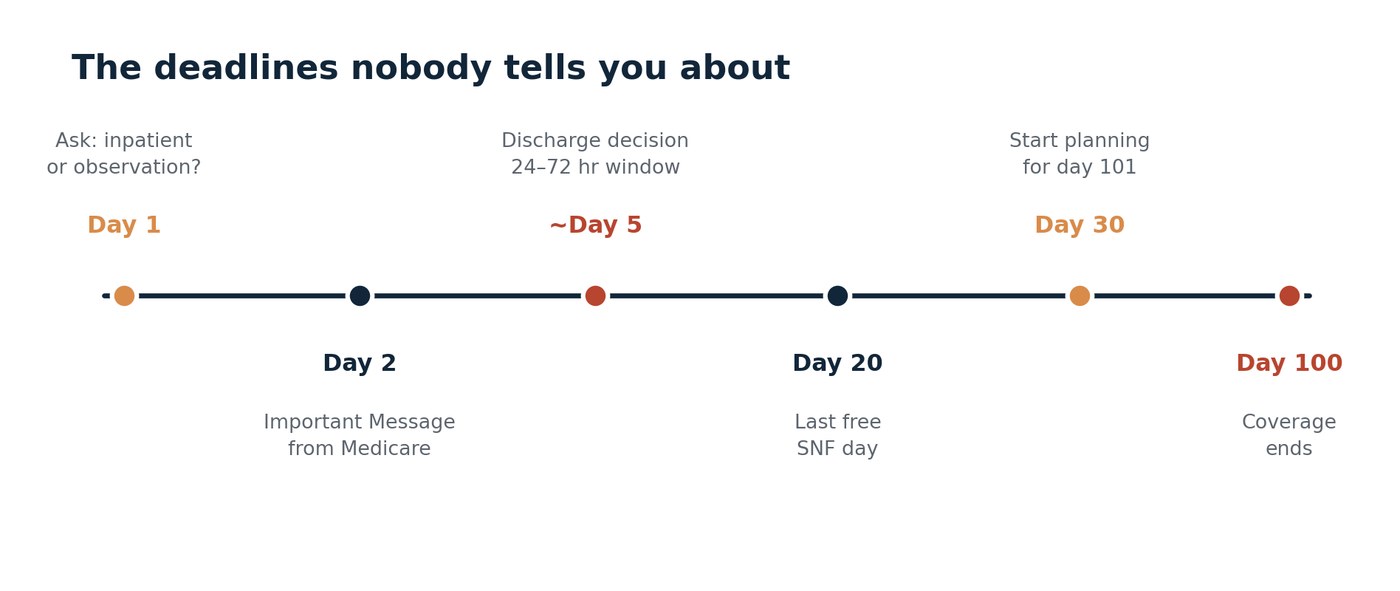
The average Medicare hospital stay is 5.3 days. Discharge planning usually begins within the first few days, and the real window to choose a facility is commonly 24 to 72 hours. Knowing that in advance is the difference between choosing and being told.
Two rights worth knowing now, before you need them
You can appeal a discharge that feels too soon. It is free, decided in about a day, and filing on time carries no financial downside. How the appeal works ›
If your parent is on Medicare Advantage, denials are frequently reversed. Federal investigators found 95% of appealed skilled nursing denials were overturned. The denial playbook ›
The one thing worth slowing down on
Money is the area where good intentions do the most damage, and where the damage is hardest to reverse.
In the first weeks, families often try to be helpful in ways that are close to impossible to undo: gifting money to "spend down," retitling assets into a child's name, selling the home quickly, or adding a child as joint owner on an account.
Each of those can trigger a penalty under Medicaid’s 60-month look-back on transfers below fair market value. And the penalty timing is the part people miss: it does not run from the date of the gift. It begins when the applicant would otherwise have qualified — which is to say, once the money is already gone.
Several of these moves also have tax consequences that run in both directions, and they depend on facts no article can know: the size of the gain, filing status, how long your parent lived in the home, how the deed is worded, and your state’s rules. There are provisions that can eliminate tax on the sale of a principal residence, and separate rules that can expose a retained home to state recovery after death. Which of them apply to your family is exactly the question to put to a professional — and exactly the thing not to guess at.
None of it is urgent in the first 48 hours. All of it should wait for an elder law attorney.
Tonight
You do not need to solve anything. You need to have asked the status question, found out whether the documents exist, got one named contact, and started writing things down.
That is the whole list. Everything else can wait until tomorrow.
The next 30 days have six deadlines
The observation-status question is the first. Then the discharge decision, the free appeal, the day-20 coinsurance jump, the day-30 planning trigger, and the coverage cliff at day 101. The 100-Day Clock is an 92-page guide with 10 fillable tools covering the whole first month — what to do, what to ask, and when.
See the guide — $9992-page PDF · 10 fillable tools · instant download · 30-day refund, no questions
Sources
- Medicare.gov — Inpatient or outpatient hospital status affects your costs
- CMS MLN Matters MM9730256 — Skilled nursing facility 3-day qualifying stay
- CMS, 2026 Medicare Parts A & B Premiums and Deductibles (November 2025)
- MedPAC, March 2025 Report to Congress — average length of stay
- CareScout 2025 Cost of Care Survey
- National Academy of Elder Law Attorneys (naela.org)
Figures verified against primary sources and current as of . Medicare amounts are reset by CMS each January — confirm the current year before acting. This article is educational reference only and is not legal, medical, or financial advice.